Table of Contents
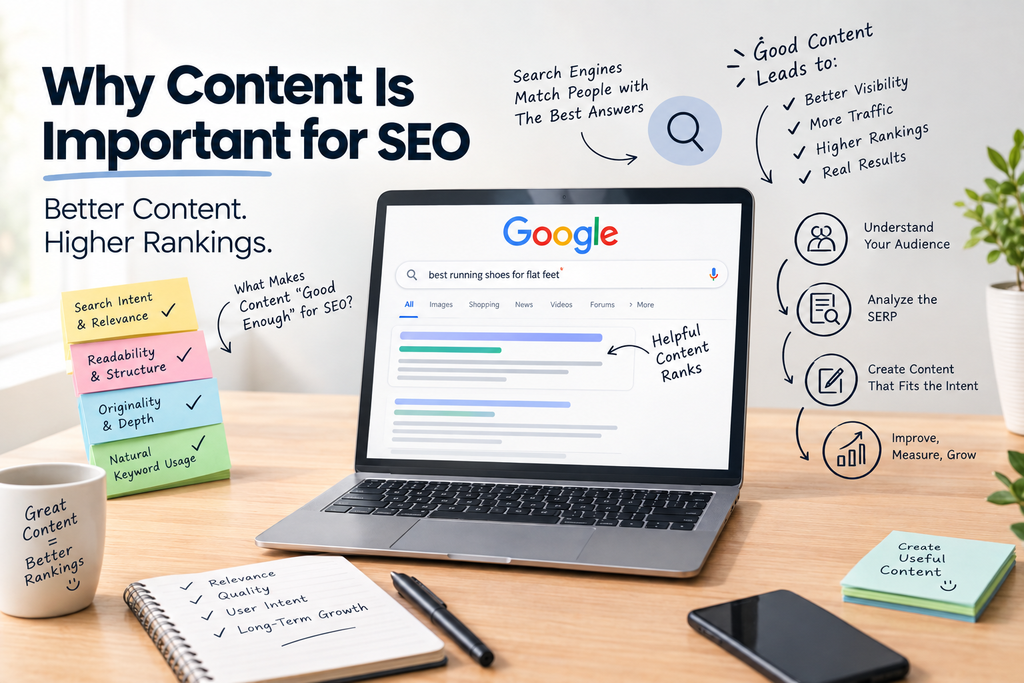
Here’s a scenario that plays out constantly: a page has solid keyword targeting, decent length, no glaring errors — and it still doesn’t rank. The team’s confused, because on paper, everything looks fine. This is almost always a content problem, not a technical one.
Why content is important for SEO comes down to one core idea: search engines are trying to match a person’s question to the page that answers it best. Links and technical setup help Google find and trust a page, but content is what determines whether the page actually deserves to be there. Google’s own Search Central guidance is explicit about this — its ranking systems are designed to reward helpful, reliable content created for people, not content built primarily to attract search traffic.
I’ll be upfront about something: I can’t point to one specific client campaign where I isolated content as the sole variable behind a ranking jump — most real-world SEO involves several moving parts at once. What I can offer is the evaluation process I actually use, and the pattern I see over and over on pages that aren’t performing.
Why Content Is Important for SEO ? What Actually Makes Content “Good Enough” for SEO
When I’m assessing a page, I don’t start with keyword density or word count. I start with search intent — whether the content clearly answers what the person searching is actually looking for. From there, the checklist runs roughly in this order:
- Search intent and relevance — does this page match what the searcher wants, not just what the keyword says?
- Originality — is there anything here beyond what’s already ranking, or is it a reshuffled version of the same five articles?
- Structure — can someone scan this and find the answer quickly?
- Readability — is it written clearly, without unnecessary complexity?
- Keyword usage — natural, not forced or repetitive.
- Helpfulness and demonstrated expertise — does it actually teach something, or just restate the obvious?
Notice that keywords sit in the middle of that list, not at the top. That ordering isn’t arbitrary — it reflects where most ranking problems actually originate.
The Most Common Mistake: Keywords Without Intent
The single most common issue on pages that aren’t ranking well is content built around keywords without properly addressing search intent. The page uses the right terms, maybe even in the right places, but doesn’t actually answer the questions the person searching has in their head. Technically optimized, practically unhelpful.
This shows up in subtle ways. A page targeting “best running shoes for flat feet” that reads like a generic shoe buying guide, with a flat-feet section bolted on at the end, is a classic example. The keyword’s there. The intent isn’t.
Google’s Helpful Content system was built specifically to catch this pattern — content created primarily for search engines rather than for the person reading it, even when it’s not spammy in any obvious way.
How to Actually Figure Out Search Intent
Guessing at intent from the keyword alone is unreliable. The more consistent approach is to look at what’s already ranking.
Here’s the process:
- Search the target keyword yourself and study what Google is actually showing — page types, formats, common subtopics, and any “People Also Ask” questions.
- Look for patterns across the top results. If eight of the top ten results are comparison-style listicles and yours is a single-product review, that’s a format mismatch worth noting.
- Compare that pattern against your actual audience’s needs. The SERP tells you what Google currently rewards; your audience tells you what would genuinely help them — those two things usually overlap, but not always perfectly.
- Build or revise content that directly satisfies that intent, rather than retrofitting an existing page to include the keyword more often.
This is a research step, not a guessing game. Skipping it is exactly how you end up with well-written content that still doesn’t match what the SERP is rewarding. Why Content Is Important for SEO
Content-First vs. Keyword-First: A Quick Comparison
| Aspect | Keyword-First Approach | Intent-First Approach |
| Starting point | The keyword itself | What the searcher actually needs |
| Research step | Keyword volume and difficulty tools | Current SERP analysis + audience needs |
| Risk | Right terms, wrong answer | Slower to produce, more likely to rank |
| Typical outcome | Technically optimized, practically unhelpful | Matches format and depth Google already rewards |
If Your Content Isn’t Ranking, Don’t Rewrite Everything Yet
When a page has “good” content on paper but still isn’t ranking, the instinct is often to scrap it and start over. Resist that.
The better first move: check whether the content actually matches search intent, and see what the currently ranking pages are covering that yours isn’t. Nine times out of ten, the issue is a specific gap — missing subtopics, wrong format, thinner coverage than competitors — not a fundamental flaw in the whole page.
Identify the gap first. Then make targeted improvements based on what that gap analysis actually shows. A full rewrite without that diagnosis risks fixing something that wasn’t broken while missing the thing that actually was.
Why Content Is Important for SEO
FAQs
Does content matter more than backlinks for SEO?
They serve different roles. Content determines whether a page deserves to rank for a given query; links and technical SEO help Google find, crawl, and trust the site. Strong content with no promotion still struggles to be discovered — but strong promotion around weak content rarely holds a ranking long-term.
How do I know if my content matches search intent?
Search the target keyword and study what Google is actually ranking — the format, depth, and subtopics of the top results are the clearest signal of what intent Google has determined for that query.
Should I rewrite a page that isn’t ranking?
Not immediately. Diagnose the specific gap first — compare your content against what’s currently ranking — then make targeted fixes rather than a full rewrite.
Conclusion: Key Takeaways
Why Content Is Important for SEO
Understanding why content is important for SEO comes down to recognizing that search engines are ultimately trying to match people with real answers, not just matching pages to keywords. To put that into practice:
- Evaluate content against search intent first, keyword usage further down the list
- Watch for the most common failure pattern: right keywords, wrong (or incomplete) answer
- Research actual SERP results before writing or revising, rather than guessing at intent
- When a page underperforms, diagnose the specific content gap before rewriting anything
- Treat content and technical SEO as complementary, not interchangeable
For businesses in Thrissur, working with a digital marketer in Thrissur can make it easier to turn quality content into meaningful online visibility. A well-planned approach combines search intent, SEO content, keyword research, and audience needs to create content that is both useful to readers and easier for search engines to understand. Whether it is improving existing website content or developing a focused SEO content strategy, the goal is to build relevant, valuable content that supports long-term search visibility and business growth.