Table of Contents

Responsible Personalization works. Consumers respond to content that feels relevant to them, and AI has made that kind of relevance easier to deliver at scale than ever before. But there’s a gap most marketers don’t talk about enough: the difference between personalization that feels helpful and personalization that feels like surveillance.
It’s about being deliberate with both. A recent Clutch survey found that 90% of consumers say protecting their privacy is important to them, yet only 55% feel confident they’re actually able to do so — and nearly half believe brands are collecting more information than necessary. That gap between what consumers want and what they trust brands to do with their data is exactly where responsible personalization has to operate.
I haven’t had a personalization campaign blow up in my face, and I won’t manufacture a dramatic story to pretend otherwise. What I have seen, consistently, is what separates personalization that builds trust from personalization that quietly erodes it. Here are five ways to get it right. A Responsible Personalization strategy focuses on creating useful experiences while giving consumers greater transparency and control over their data. Responsible Personalization helps marketers create relevant experiences while respecting consumer privacy, consent, and expectations.
1. Use Only Data the Audience Has Knowingly Shared
The clearest line I follow: use data that’s necessary to make content more relevant, and that the audience has willingly given you. Not inferred. Not purchased. Not scraped from some third-party source they’ve never heard of. Shared. At the core of Responsible Personalization is a simple principle: personal data should be used with awareness, purpose, and respect. Responsible Personalization starts with using information that customers have intentionally chosen to share, rather than relying on hidden or questionable data sources.
This matters because consumers can usually tell the difference, even if they can’t articulate exactly how. Content that references a stated preference feels thoughtful. Content that references something you’d have no obvious way of knowing feels invasive — even if the personalization itself is technically accurate.
Practical tip: Before using any data point, ask whether the audience member would be surprised you have it. If the answer is yes, that’s a signal to hold back, not to lean in. This simple check can help keep Responsible Personalization focused on what customers expect rather than what technology makes possible.
2. Keep Personalization Subtle and Useful, Not Just Clever
Personalization tends to land well when it’s relevant, transparent, and subtle — built around interests or preferences someone actually told you about. It tends to land badly when it’s designed to impress rather than to help. Responsible Personalization should make an interaction feel more relevant, not make the customer wonder how much the brand knows about them.
There’s a real temptation in content marketing to show off what your data or AI tools can do. Referencing five different data points in one email might feel impressive from the inside, but from the outside, it often reads as “this company knows a lot about me, and that’s a little unsettling.”
The better standard: does this personalization make the content more useful to them, or does it mainly demonstrate what you’re capable of tracking? Those aren’t always the same thing. The goal of Responsible Personalization is to make every personalized interaction more useful without making customers feel watched or tracked. A Responsible Personalization approach gives marketers a clear way to balance relevance with necessity, consent, transparency, and audience value.
3. Follow a Simple Necessity-and-Consent Framework
Rather than deciding data use case-by-case with no consistent logic, it helps to run everything through the same short framework:
- Is this data necessary to make the content meaningfully more relevant?
- Did the audience knowingly share it (not just technically consent via buried terms)?
- Is it sensitive or overly personal information that doesn’t belong in marketing at all?
- Does using it add clear value for the person receiving the content?
If a use case fails any of these, it doesn’t move forward — regardless of what the data or AI tooling makes technically possible. Sensitive or overly personal information gets excluded outright, and transparency and consent get prioritized before any personalization touch gets added.
This isn’t a complicated framework. That’s kind of the point — a rule of thumb that’s easy to apply consistently beats a sophisticated policy nobody actually follows under deadline pressure.
4. Let AI Support the Work, Not Make the Privacy Calls
AI is genuinely useful here — for analyzing patterns in what content resonates, and for generating relevant content variations faster than a human could alone. That’s a legitimate, valuable role.
Where it shouldn’t sit is in the driver’s seat on anything involving privacy, sensitive information, consent, or potential impact on consumer trust. Those decisions need to stay human-led. AI can suggest, surface patterns, and speed up production — but the judgment call on whether a piece of personalization crosses a line belongs to a person who understands the stakes, not a model optimizing for engagement.
This distinction matters more as AI tools get better at inferring things audiences never explicitly shared. The fact that a model can infer something isn’t permission to use it. Responsible Personalization keeps human judgment at the center when AI identifies patterns that could involve sensitive or inferred information.
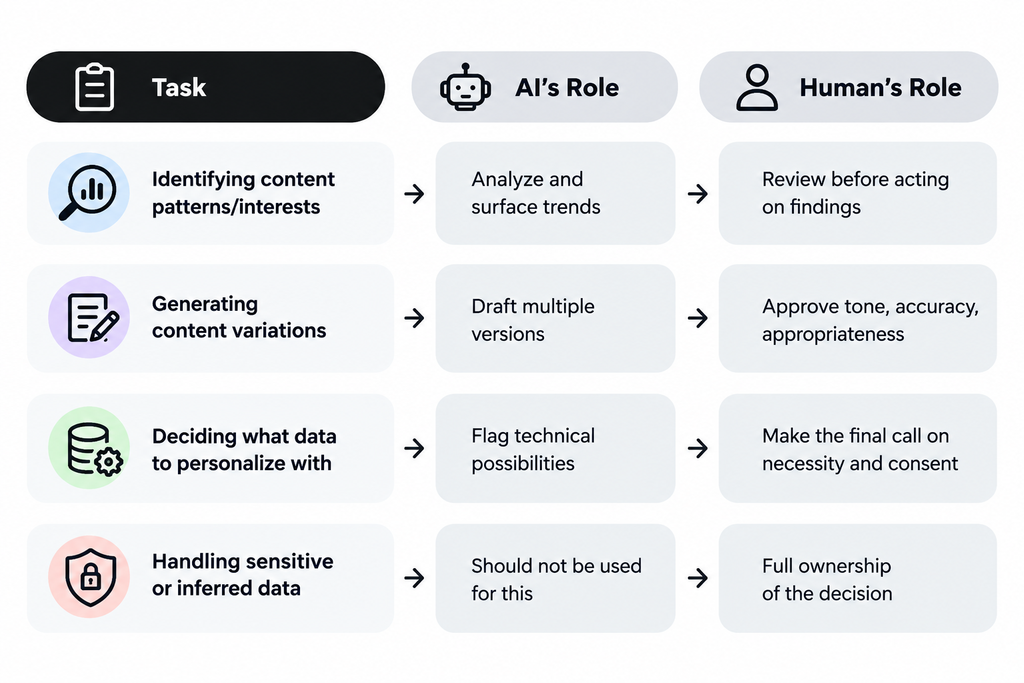
Where This Framework Applies in Practice
| Task | AI’s Role | Human’s Role |
| Identifying content patterns/interests | Analyze and surface trends | Review before acting on findings |
| Generating content variations | Draft multiple versions | Approve tone, accuracy, appropriateness |
| Deciding what data to personalize with | Flag technical possibilities | Make the final call on necessity and consent |
| Handling sensitive or inferred data | Should not be used for this | Full ownership of the decision |
Picture Reprasention;
5. Audit Before You Launch — Every Time
Before any personalization or AI feature goes live, run through three checks: what data is being used, whether it was collected with clear consent, and whether the personalization genuinely benefits the audience rather than just the brand. This final check is an important part of Responsible Personalization, ensuring that available data is used because it serves the audience, not simply because technology makes it accessible. Regular audits help ensure that Responsible Personalization remains aligned with consumer expectations as marketing tools and data sources evolve.
The biggest mistake to avoid here is using data simply because it’s available. Availability isn’t the same as appropriateness. For Responsible Personalization, the question is not simply whether data is available, but whether using it is necessary, appropriate, and valuable to the audience.Just because a system can pull in someone’s browsing history, location, or past purchase behavior doesn’t mean doing so makes the content better for them — and using it anyway, just because the capability exists, is one of the fastest ways to make personalization feel intrusive instead of helpful.
FAQs
Understanding Responsible Personalization becomes easier when marketers look at how privacy, consent, AI, and audience value work together in everyday marketing decisions
What does “responsible personalization” actually mean?
It means using only data your audience has knowingly shared, limiting personalization to what genuinely benefits them, and keeping AI in a supporting role rather than letting it make final calls on privacy-sensitive decisions.
Can AI be trusted to decide what personal data to use in marketing?
AI is useful for analyzing patterns and generating content variations, but decisions involving privacy, consent, and sensitive information should stay human-led rather than automated.
How do I know if personalization has gone too far?
A useful test: if the audience would be surprised you know something about them, that’s a sign to hold back. Personalization should feel like relevance, not surveillance.
Conclusion: Key Takeaways
Responsible Personalization is ultimately about creating meaningful relevance without compromising the trust customers place in a brand. Responsible Personalization is not about using less technology; it is about using data and AI with greater purpose, transparency, and care. When practiced consistently, Responsible Personalization can help brands deliver relevant content while protecting the trust that makes long-term customer relationships possible. Building consumer trust through responsible personalization comes down to discipline more than technology. The brands getting this right tend to:
- Use only data the audience has knowingly and willingly shared
- Keep personalization subtle, relevant, and genuinely useful — not just technically impressive
- Follow a consistent necessity-and-consent framework rather than deciding case by case
- Let AI support analysis and content creation while keeping privacy decisions human-led
- Audit every personalization feature before launch, checking data source, consent, and real audience benefit
For businesses looking to strengthen their online presence, working with a digital marketer in Thrissur can provide a more focused and locally relevant approach to digital growth. From SEO and social media marketing to Google Ads and website optimization, the right strategy can help businesses improve visibility, reach their target audience, and build meaningful connections online. A strong understanding of the local market, audience behaviour, and changing digital trends also helps create strategies that are practical, relevant, and aligned with long-term business goals.