Table of Contents
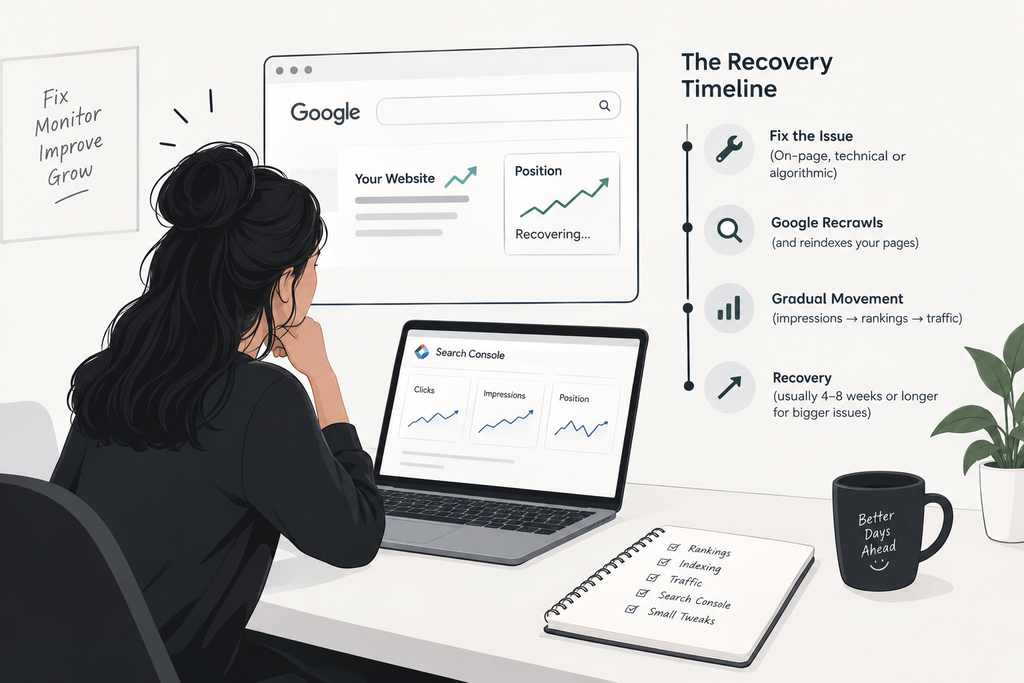
You fix the issue. You wait. Nothing happens. You start refreshing Search Console every hour like it’s going to change anything.
I’ve been on both sides of this — the person waiting, and the person telling a client to hang on a little longer. And here’s the thing most people get wrong about SEO ranking recovery time: fixing the problem is only step one. Google still needs time to notice the fix, trust it, and act on it. Understanding SEO Ranking Recovery Time helps you set realistic expectations and avoid making unnecessary changes while Google is still processing your fixes.
Google’s own John Mueller has confirmed this directly. Responding to a site owner asking about recovery timelines, he said that Google still doesn’t hold a grudge and sites will recover once issues are fixed, but noted that fixing issues tied to bigger algorithmic changes can take quite some time — sometimes many months — before the effects show up. That’s not a vague reassurance. It’s Google directly setting the expectation that recovery isn’t instant, even when you’ve done everything right. searchenginejournal
How Long Does SEO Ranking Recovery Time Actually Take?
From what I’ve seen with on-page and technical fixes specifically, recovery usually lands somewhere in the 4 to 8 week range. Once the changes are live and Google has had a chance to recrawl and reindex the affected pages, rankings tend to move gradually — not in one dramatic jump, but step by step as the crawl catches up. The actual SEO Ranking Recovery Time depends on the severity of the issue, the type of changes made, and how quickly Google crawls and reindexes the affected pages.
That’s a different timeline than what Mueller was describing, which involved broader algorithmic or spam-related drops. Those can take considerably longer — sometimes months — because Google isn’t just recrawling pages, it’s reassessing the whole site’s standing. The takeaway: the type of issue you’re recovering from changes how long you should realistically expect to wait.
Before estimating your SEO Ranking Recovery Time, it’s important to identify whether the ranking drop came from a technical issue, content problem, algorithmic change, or accidental indexing block.
| Issue Type | Typical Recovery Window | What’s Happening Behind the Scenes |
| On-page optimization fixes | 4–8 weeks | Recrawl + reindex of updated pages |
| Technical SEO issues (crawl errors, broken tags) | 4–8 weeks | Recrawl + validation of fix |
| Broad algorithmic/spam-related drops | Several months | Full site reassessment, next update cycle |
| Accidental full-site blocks (robots.txt, noindex) | Days to weeks once corrected | Fast recrawl once the block is lifted |
What to Actually Do While You’re Waiting
Waiting doesn’t mean doing nothing. During a recovery window, I stay in monitoring mode — tracking rankings, indexing status, traffic, and Search Console data closely, and making small, targeted optimizations based on what the data is actually showing. Not big swings. Small, informed adjustments. Tracking your progress during the SEO Ranking Recovery Time can help you understand whether Google is responding positively to the changes you have made.
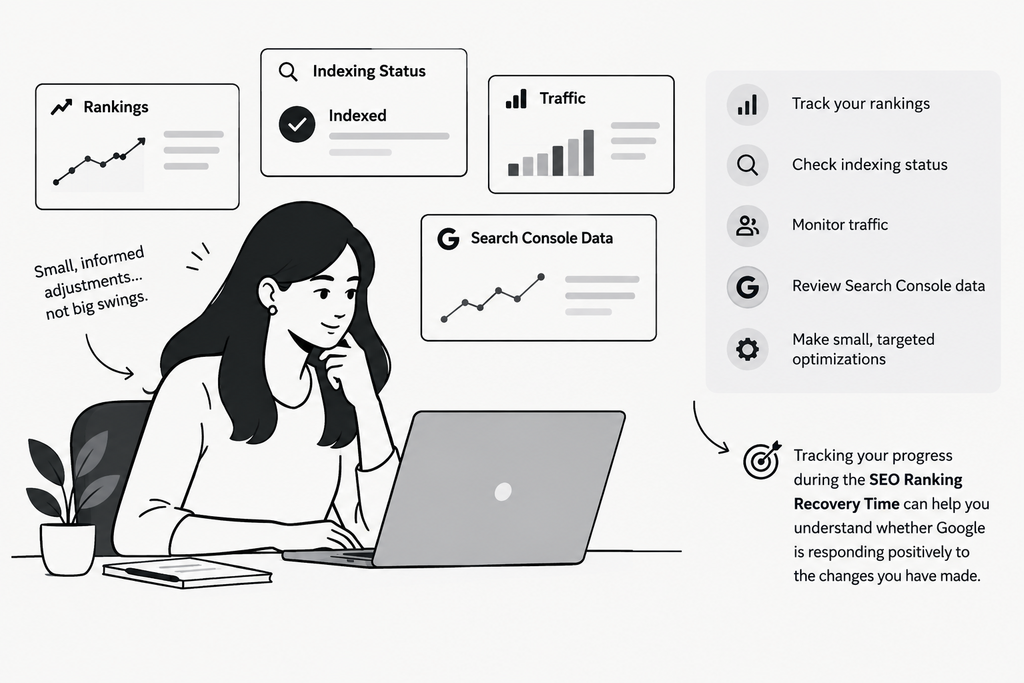
Here’s what that looks like in practice:
- Check indexing status regularly. Confirm Google has actually recrawled the pages you fixed — not just submitted them.
- Watch impressions before rankings. Impressions often start recovering before positions stabilize, which is an early signal worth paying attention to.
- Track traffic alongside rankings. A ranking bump that doesn’t bring traffic (or vice versa) tells you something’s still unsettled.
- Make small, data-backed tweaks. If something’s clearly off, adjust it — but don’t overhaul what you just fixed.
- Log what changed and when. Without a timeline, you won’t be able to tell what actually worked once recovery happens.
A Real Example: When Impressions Recovered Before Rankings Did
In one case I worked on, Search Console showed impressions climbing again while rankings were still bouncing around, not yet stable. It would’ve been easy to panic at that point and start making bigger changes. Instead, I kept watching the data and gave the existing fixes more time to settle. That patience paid off — the rankings eventually caught up to what the impression data had already been hinting at. Search Console impressions, clicks, indexing data, and ranking changes can provide useful clues about your SEO Ranking Recovery Time and whether recovery is moving in the right direction. This is why SEO Ranking Recovery Time should be evaluated through several indicators rather than relying on ranking position alone.
That’s the pattern worth remembering: impressions moving before rankings do is often a sign that Google is in the middle of reassessing things, not a sign that the fix failed. This experience also shows why SEO Ranking Recovery Time should be judged using multiple SEO signals rather than rankings alone.
The Biggest Mistake: Changing Too Much, Too Fast
If there’s one thing I’d flag as the most common — and most damaging — mistake, it’s making too many changes too quickly during the recovery window. Swapping keywords, rewriting content again, restructuring the site, all before Google has finished processing the first round of fixes.
The problem isn’t just wasted effort. It’s that you lose the ability to tell what actually worked. If three things changed in the same two-week window and rankings move, which one caused it? You genuinely won’t know — and that means you can’t repeat the win or avoid the mistake next time.Trying to shorten SEO Ranking Recovery Time by repeatedly changing the same pages can make the recovery process harder to measure.
Recovery requires a bit of discipline here. Fix the issue, then let it breathe.
Having a realistic view of SEO Ranking Recovery Time makes it easier to distinguish between normal fluctuations and a situation that genuinely needs further investigation.
When to Actually Reassess vs. Keep Waiting
Trying to shorten SEO Ranking Recovery Time by making constant changes can sometimes make recovery harder to measure and may delay your ability to identify what actually worked. Your expected SEO Ranking Recovery Time should be treated as a monitoring window rather than a guaranteed deadline for rankings to return.. Patience has a limit, and it shouldn’t be indefinite. Here’s a simple way to think about it:
- Weeks 1–4: Expect little to no visible movement .Understanding.
- Weeks 4–8: Gradual movement is normal here — impressions ticking up, rankings fluctuating rather than climbing steadily.
- Past 8 weeks with zero movement: This is the point to reassess. Check whether the original issue is fully resolved, look for anything new that might be interfering, and consider whether a different or additional fix is needed .The goal isn’t to predict an exact SEO Ranking Recovery Time, but to use these checkpoints to make better decisions based on what the data is showing.
This isn’t a hard rule that applies identically to every site — competitive keywords, site size, and the type of issue all shift the timeline. But it’s a reasonable checkpoint system rather than guessing.
FAQs
Knowing the expected SEO Ranking Recovery Time gives you a practical point at which to decide whether to keep monitoring or investigate the problem again.
How long does it take for Google to recognize an SEO fix?
For on-page and technical fixes, expect 4–8 weeks for gradual recovery, based on recrawl and reindex timing. Broader algorithmic issues can take considerably longer — sometimes months, according to Google’s own statements. For on-page and technical fixes, SEO Ranking Recovery Time can often fall within a 4–8 week monitoring window, based on recrawl and reindex timing. Broader algorithmic issues can take considerably longer — sometimes months, according to Google’s own statements.
Should I make more changes if rankings haven’t recovered after a few weeks?
Not immediately. Give it the full 4–8 week window first. Making repeated changes too early makes it harder to identify what’s actually working. SEO Ranking Recovery Time can help you avoid reacting to normal ranking fluctuations too quickly. Focus on confirming the fix is live and indexed.
Is a gradual ranking increase normal, or should I expect a sudden jump?
Gradual is the norm. Rankings typically move step by step as Google recrawls and reindexes updated pages, rather than jumping all at once.
Conclusion: Key Takeaways
SEO ranking recovery time isn’t a fixed number, but there are patterns worth trusting:
- On-page and technical fixes typically show gradual recovery within 4–8 weeks.
- Broader algorithmic issues can take Google significantly longer to reassess — sometimes months, per Google’s own guidance.
- Monitoring data (impressions, indexing, traffic) beats passive waiting — but resist the urge to overhaul things mid-recovery.
- Impressions often recover before rankings stabilize — that’s a signal to stay the course, not panic.
- If there’s still no movement after 8 weeks, that’s the point to reassess, not before.
- Ultimately, monitoring SEO Ranking Recovery Time is about balancing patience with analysis: give Google enough time to process your fixes while continuing to watch the data for meaningful changes.
As a digital marketer in Thrissur, I help businesses build a strong online presence through practical and result-focused digital marketing strategies. I focus on SEO, social media marketing, Google Ads, content, and website optimization to improve online visibility and connect businesses with the right audience. My approach is simple — understand your business goals, create the right strategy, and continuously optimize it for meaningful growth.