Table of Contents
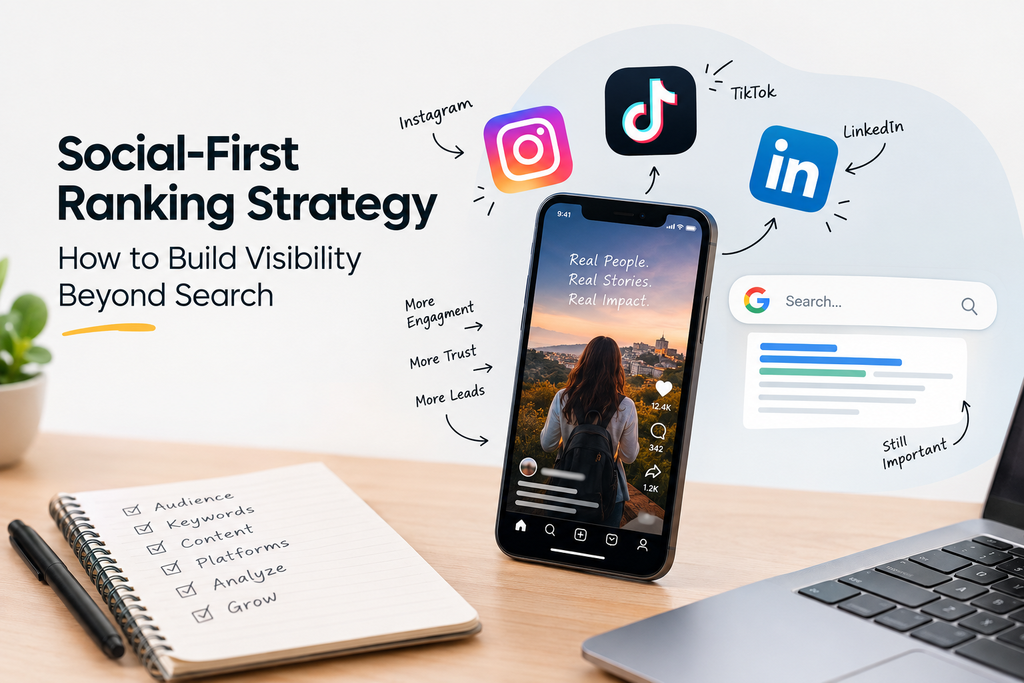
A few years back, I’d have told you that ranking on Google was the finish line. Nail the keyword, build some backlinks, optimize the page — the traffic follows. Then I watched a single social media post pull in more engagement and enquiries than a website page that was already ranking well for its target term.
That one moment reshaped how I think about visibility altogether.
This isn’t a theory piece. It’s the process I actually run with clients, the mistakes I’ve watched people make (myself included, more than once), and the platform-specific tactics that keep moving the needle when everything else plateaus .A Social-First Ranking approach brings these channels together, helping brands build visibility across social platforms while supporting their broader search and content strategy.
Why Social-First Ranking Matters Now
Social-First Ranking recognizes that brand visibility is no longer limited to traditional search engines and that audiences can discover, evaluate, and engage with businesses across multiple digital platforms..
People just don’t find brands the way they used to. A growing chunk of searches now start on TikTok, Instagram, or LinkedIn instead of Google — particularly with younger audiences, who’ll trust a shaky 30-second video from a real person over a polished landing page any day. An April 2024 survey by Forbes Advisor and Talker Research put a number on it: 45% of Gen Z said they’re more likely to “social search” on platforms like TikTok and Instagram than turn to Google, compared with roughly 35% of millennials and 20% of Gen X .With Social-First Ranking, the goal is to make your content discoverable in the environments where your target audience is already searching, scrolling, and making decisions.
I saw this play out first-hand with a client. Their website page was solid — well-optimized, ranking decently — but a social post still outperformed it on both engagement and enquiries. Not a fluke. It was proof that discovery doesn’t live in one place anymore, and brands that only chase search rankings are leaving trust (and leads) sitting on the table.
None of this means SEO is dead, to be clear. A social-first approach works with traditional search optimization, using social platforms as discovery engines that feed traffic and credibility back into everything else.
A practical Social-First Ranking strategy connects audience insights with content creation, platform optimization, and ongoing performance analysis.
The Process I Actually Use
A Social-First Ranking strategy combines audience research, keyword insights, engaging content, and platform-specific optimization to create stronger opportunities for discovery. .This has settled into something fairly repeatable over the years. Nothing groundbreaking here — but skip the wrong step early on, and it costs you later. A strong Social-First Ranking strategy starts by understanding where your audience searches, what content they engage with, and how each platform can contribute to overall brand visibility.
Here’s the order it runs in:
- Understand the audience and the goal — who you’re speaking to, and what they actually need right now.
- Dig into keyword research and social trends together, since they overlap more than most people expect.
- Build platform-specific content rather than one asset stretched across every channel.
- Optimize for both search and engagement — captions, hooks, on-screen text, all of it.
- Track what’s actually happening: engagement, reach, saves, enquiries.
- Adjust based on what the data says, then repeat.
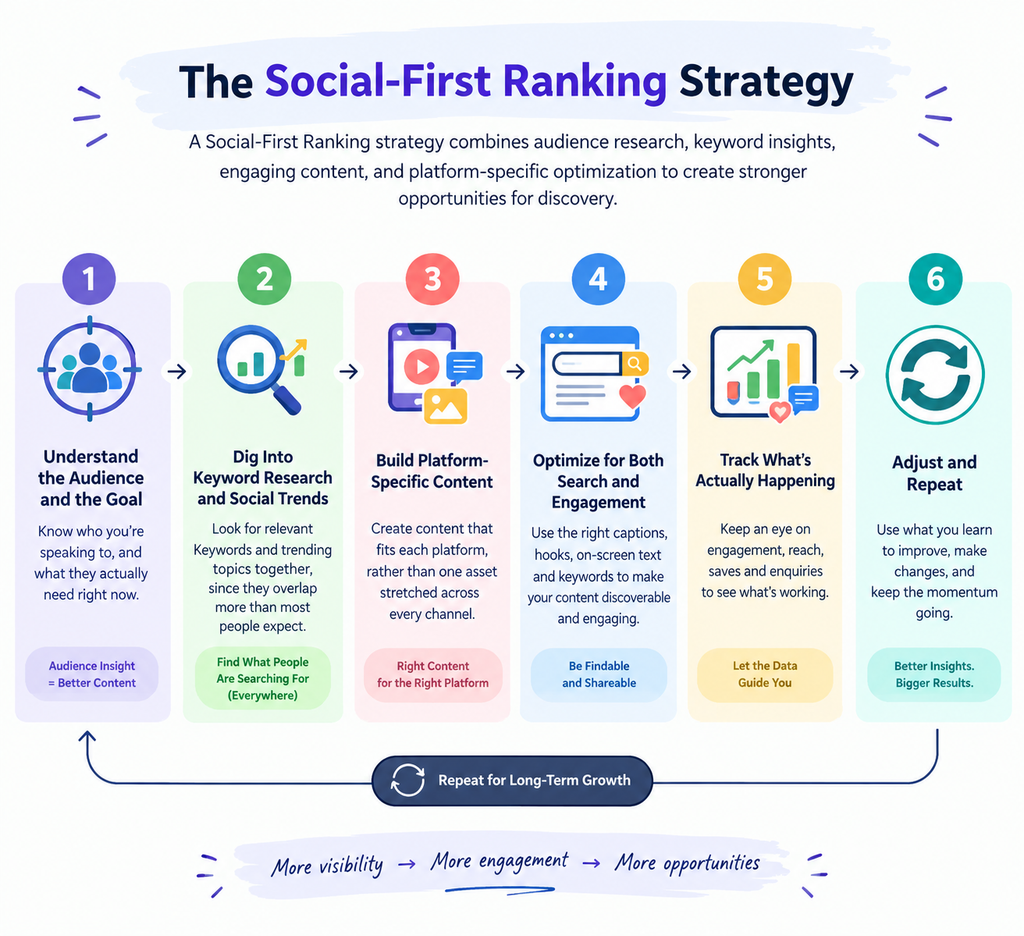
The strength of Social-First Ranking comes from connecting these steps rather than treating social media, content marketing, and SEO as completely separate activities.Out of all of these, the step people skip most is the first one. And skipping it causes almost everything downstream to wobble.
What Happens When You Skip the Audience Research
Audience understanding is at the heart of Social-First Ranking because content performs better when it reflects the questions, interests, and needs of the people you want to reach. Content that goes out before you’ve actually figured out who it’s for tends to reach… well, the wrong people. Even when it’s technically well-optimized. The pattern is pretty familiar at this point: low engagement, weak trust, enquiries that don’t go anywhere.
I’ve watched this happen with campaigns that tried to speak to “everyone” and ended up landing with no one in particular. One case that sticks with me: a campaign was underperforming because the messaging was too broad — trying to cover too much ground at once. Once we went back and tightened the audience research, figuring out exactly who the content needed to reach and what mattered to them, things shifted. Engagement climbed noticeably within a few weeks, and the enquiries coming in afterward were far more qualified.
Short-form video did most of the heavy lifting in that turnaround. It gave the sharper, more targeted message somewhere to actually land.
Worth setting expectations here too — a few weeks is realistic for this kind of pivot. It’s not an overnight fix, but once the content starts resonating, momentum tends to build fast.
Platform-by-Platform: What Actually Changes
Social-First Ranking requires a platform-specific approach because the signals that help content gain attention can differ between Instagram, LinkedIn, TikTok, and traditional search. Here’s something people underestimate: a social-first strategy isn’t “one piece of content, posted everywhere.” The same core message needs a different shape depending on where it shows up. A practical Social-First Ranking strategy starts with one clear audience need and adapts the content around the behavior and expectations of each platform. Social-First Ranking requires more than publishing consistently; it requires understanding how each platform presents content and how audiences interact with it.
| Platform | Primary Focus | Content Style |
| Visual storytelling, short-form content | Reels, carousels, aesthetic-driven posts | |
| Professional value, credibility | Insight-driven posts, thought leadership, case studies | |
| TikTok | Trend-relevance, discovery | Fast-paced, authentic, trend-aware short video |
A successful Social-First Ranking strategy adapts the same core idea to each platform without losing the message, personality, or purpose behind the content.
Social-First Ranking isn’t about being active on every platform; it’s about creating the right content for the right audience in the places where they are most likely to discover and engage with your brand. .Instagram leans visual — short-form video and carousels do most of the work there. LinkedIn is almost the opposite: it rewards value-driven, credibility-building content over anything flashy. TikTok sits somewhere in between, needing to feel trend-aware and fast without losing the brand’s actual voice in the process.
Run the exact same content across all three, unedited, and you’ll usually underperform everywhere at once — not just on one platform.
Mistakes I’d Tell You to Avoid
One common Social-First Ranking mistake is focusing on how often you post instead of whether your content is relevant and useful to the audience you want to attract.
- Skipping audience research to save time. It feels faster short-term; it costs you engagement and trust later.
- Chasing a trend just to “stay visible,” with no real strategy behind it.
- Posting on a schedule for the sake of consistency, without checking whether it’s actually relevant to anyone watching.
- Treating every platform identically, instead of adjusting for how people actually use each one.
If You’re Just Starting Out
For beginners, Social-First Ranking can be approached by choosing one relevant platform, understanding its audience, and consistently creating useful content before expanding to additional channels. Start with the audience, not the content calendar. Figure out who you’re genuinely trying to help, and build around what’s actually useful to them — that one decision shapes everything else: platform choice, tone, format, even how you measure whether it’s working.
And skip the trend-chasing. Posting for visibility alone, without a strategy underneath it, rarely converts into anything meaningful. Consistency matters, sure — but relevance matters more. Being everywhere means nothing if it’s not landing with the right people.
Social-First Ranking works best when social visibility and traditional SEO support the same broader goal: helping the right audience discover and trust your brand.
FAQs
Is social-first ranking a replacement for SEO?
No — it works alongside it. Search and social increasingly overlap in how people discover things, and a solid strategy leans on both.
How long before I see results?
In my experience, a few weeks is typical once audience targeting and content relevance are actually dialed in — though it varies by industry and platform.
Which platform should I start with?
Wherever your specific audience already spends their time — not whatever’s trending. Instagram, LinkedIn, and TikTok each serve different habits, so pick based on fit.
What is Social-First Ranking?
Social-First Ranking is an approach that focuses on improving brand visibility across social platforms while connecting social discovery with broader SEO and content marketing efforts.
Key Takeaways
A social-first ranking strategy doesn’t mean abandoning SEO — it means accepting that discovery now happens across more places than search alone. The goal of Social-First Ranking is to expand your brand’s discoverability beyond traditional search by connecting useful, platform-specific content with the audiences already looking for it. What tends to separate the brands that get this right:
- They research the audience before building content, not after
- They adapt tone and format per platform instead of copy-pasting
- They chase relevance over trend-hopping and raw posting frequency
- They give a strategy shift a few real weeks before judging it
For businesses looking to strengthen their online presence, working with a digital marketer in Thrissur can provide a more focused and locally relevant approach to digital growth. From SEO and social media marketing to Google Ads and website optimization, the right strategy can help businesses improve visibility, reach their target audience, and build meaningful connections online. A strong understanding of the local market, audience behaviour, and changing digital trends also helps create strategies that are practical, relevant, and aligned with long-term business goals.